Citable GEO First Cohort Playbook: Appear in AI Answers in 2–3 Weeks
A repeatable system to build your first cohort of AI-citable content and achieve measurable visibility in generative answers within 2–3 weeks, with minimal budget.
 Cole Leng
Contents
Author: Cole, Founder of Citable
Date Published: February 1, 2026
Last Updated: February 1, 2026
Reading Time: 8–12 minutes
Executive Overview (TLDR)
Generative Engine Optimization (GEO) is no longer optional for B2B SMBs. When buyers search on ChatGPT, Perplexity, or Google AI Overviews, your brand must be cited as a trusted source—not just ranked on SERP anymore.
This "Citable GEO First Cohort Playbook" gives content and marketing leaders a repeatable system to build your first cohort of AI-citable content and achieve measurable visibility in generative answers within 2–3 weeks, with minimal budget.
The core insight: Research shows 76% of AI-cited pages rank in Google's top 10, and 43.8% of ChatGPT sources originate from "Best X" listicles. You don't need massive domain authority. You need structured, authoritative content placed where AI systems extract citations first.
This guide is designed for budget-conscious SMB founders and content leaders who can execute internally. Most actions described below cost zero dollars. Tools like Citable (Full-stack GEO platform) offer accelerate Week 3+ scaling.
Step 1: Brand AI Visibility Baselining (Week 1)
1.1 Document Your Brand Value Proposition (Top 3)
Define what AI systems should cite you for. This is not marketing tagline—it's the specific problem solved plus proof.
Example framework:
-
Value 1: Primary differentiation with outcome metric
"25% faster ROI on predictive maintenance implementation vs. industry standard" -
Value 2: Secondary proof point (customer count, certification, research)
"Trusted by 500+ enterprise manufacturers across Fortune 100" -
Value 3: Category leadership or unique positioning
"Only solution combining real-time sensor fusion + domain expertise on steel manufacturing"
Write these as citation-friendly statements under 20 words. These seed your prompt testing and become anchor text for internal links.
1.2 Competitive AI Visibility Audit (2–4 Hours)
Run identical prompts across three AI systems: ChatGPT, Perplexity, Google AI Overviews. This reveals baseline citation gaps and competitive positioning.
Start with 5–10 prompts:
- "Best [your category] tools for [buyer persona]"
- "How to [core problem you solve]"
- "Compare [your solution] vs. [competitor]"
- "What's the ROI of [your solution type]?"
- "[Your category] for [specific use case]"
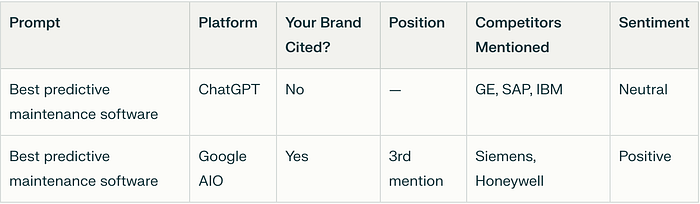
Track in spreadsheet:

Insight: If you're not appearing, you're invisible to AI. If you're 3rd, you're mentioned but not primary. Both are fixable in 2–3 weeks with this playbook.
1.3 Technical GEO Quick Audit (15 Minutes)
AI systems reward structural clarity. Run this audit on your 3 highest-traffic pages:
Must-have signals:
- ✅ [Required] Schema markup present (Organization, Article, FAQ via JSON-LD)
- ✅ [Required] H1/H2/H3 hierarchy (single H1, logical flow)
- ✅ [Required] Publication + last-updated date visible
- ✅ Mobile speed <1.8s — Ranked signal
Quick wins if missing:
- Schema markup: 10 minutes via Citable's JSON-LD generator
- Heading cleanup: 1 minute via Citable's blog optimizer
- Date visibility: Add to template (5 minutes)
Note: If you lack these signals, add them before creating new content. Structural clarity is prerequisite, not optional.
1.4 Get Top 10 AI-Preferred Listicles (Captures 53% of AI Citations)
Listicles dominate AI citations (for now). Run these searches in each AI platform:
- "Best [your category] tools"
- "Best [your category] for [use case]"
- "Top 10 [your category] companies"
- "[Your category] comparison 2026"
Collect the top 3 listicles for each search:
- URL, publication date, domain authority
- Number of items listed
- Whether your brand is mentioned
- Writing style, structure, tone
- External links included
- Content freshness signals
Why this matters: Research shows listicles capture 52.9% of all AI citations, averaging 6.3 citations per source. When answering "best tool" queries, 77% of high-citation sources are listicles. Understanding listicle structure now accelerates Week 2 inclusion strategy.
1.5 Run First Cohort of Prompt Testing (20–30 Prompts)
Test 20–30 real user prompts across all three AI platforms once as baseline. You'll re-run this exact set weekly to track progress.
Organize by intent + stage:

Awareness Stage:
- "What is [category]?"
- "How does [solution type] work?"
- "Why use [solution]?"
Consideration Stage:
- "Best [solution] for [use case]"
- "[Solution A] vs [Solution B]"
- "How to choose [solution]"
Decision Stage:
- "[Your brand] review"
- "[Your brand] pricing"
- "Is [your brand] worth it?"
Spreadsheet tracking: For each prompt, log:
- Prompt text
- Platform (ChatGPT / Perplexity / Google AIO)
- Your brand mentioned? (Y/N)
- Your brand cited with link? (Y/N)
- Position (1st–5th mention, or 6+)
- Competitors mentioned
- Date tested
Week 1 baseline: If 20% appear (6 of 30), that's starting point. Target 50%+ by Week 3.
Step 2: Structured Prompt Research (Week 1–2)

2.1 Gather Raw Data From Three Sources
Source 1: Client Calls & Sales Conversations
Have your sales team (or you) log exact buyer language:
"What question triggered this conversation?"
Collect 20–30 of these. These mirror real AI prompts.
Source 2: 90-Minute Internal Workshop
Content + product + sales brainstorm:
- "Top 10 questions our best customers ask?"
- "What misconceptions derail deals?"
- "What comparisons do we lose to?"
- "What terminology confuses the market?"
Write everything. Don't filter yet.
Source 3: Use AI to Expand Research Questions
Use this prompt in ChatGPT:
"I'm planning to choose a [product/service category] for my [use case/role]. Help me create a comprehensive list of questions I should ask when researching and comparing [product/service category]."
AI will generate:
Awareness Stage:
- "What is [category]? How does it work?"
- "How is [category] different from [alternative]?"
- "Why do companies use [category]?"
Consideration Stage:
- "How much does [category] cost? What are typical pricing models?"
- "What are key features to look for?"
- "How long does implementation take?"
Decision Stage:
- "What are the risks/downsides?"
- "What support is available?"
- "What results can I expect in X months?"
This typically generates 30–50 questions per category.
2.2 Cluster and Prioritize (1 Hour)
Group your 50–75 questions into themes:
- Foundational (What/Why/How) – Build these first
- Comparison (Us vs. Them) – High citation value
- Use Case Specific – Long-tail wins
- Implementation/ROI – Decision-stage content
Prioritize by:
- Search volume (if available)
- Sales team feedback
- Competitive gap analysis from Step 1.2
Pick 3–5 clusters for Week 2 content production.
Step 3: Create Your First Content Cohort (Week 2)
3.1 Hub-and-Spoke Content Architecture
Create one "hub" article (2,000+ words) + 2–3 "spoke" articles (1,000 words each) that link back to the hub.
Hub example: "Complete Guide to [Your Category]"
Spokes:
- "How to Choose [Your Category] for [Use Case]"
- "[Your Category] vs. [Alternative Solution]"
- "Best [Your Category] Tools in 2026"
3.2 AI-Optimized Content Structure
Every article must include:
- Clear H1 question-based title
- TL;DR section (2–3 sentences at top)
- Author byline with credentials
- Publication + last updated date
- Logical H2/H3 hierarchy
- Data/statistics with sources
- Visual examples (screenshots, diagrams)
- Internal links to related content
- External links to authoritative sources
- Schema markup (Article, FAQ, HowTo)
Content depth guidelines:
- Definitions: 800–1,500 words
- How-to guides: 1,500–3,000 words
- Comparisons: 1,200–2,500 words
- Best practices: 2,000–4,000 words
3.3 Distribution Strategy
Publish simultaneously across:
- Your blog (primary canonical source)
- LinkedIn article (reach + authority signal)
- Medium (syndication with canonical tag)
- Substack (email + discovery)
- Reddit (relevant subreddits, authentic participation)
Cross-link everything. AI systems follow link graphs aggressively.
3.4 Listicle Inclusion Strategy
From Step 1.4, you have 10+ target listicles. Reach out to authors:
Email template:
Subject: Update for "[Article Title]" – New [Category] Data
Hi [Author],
I'm [Your Name], founder of [Your Brand]. I noticed your excellent article "[Article Title]" from [Date].
We recently published [relevant research/guide] that your readers might find valuable: [Link]
Specifically, we cover [unique angle that complements their article].
Would you be open to including us in your roundup? Happy to provide any additional context.
Best,
[Your Name]
Target 5–10 listicles per week. Success rate: 15–25% for well-targeted outreach.
Step 4: Measurement & Iteration (Week 2–3)
4.1 Weekly Prompt Testing Cadence
Every Monday morning:
- Re-run your 30 baseline prompts across all platforms
- Track changes in citation frequency
- Note new competitors appearing
- Document any shifts in positioning
4.2 Track These Metrics
| Metric | Week 1 | Week 2 | Week 3 | Target |
|---|---|---|---|---|
| Citation frequency | 50%+ | |||
| Average position | Top 3 | |||
| Platforms citing | 2+ | |||
| Listicle inclusions | 3+ | |||
| AI-attributed traffic | Measurable |
4.3 Iteration Triggers
If citation rate not improving by Week 2:
- ✅ Check schema implementation
- ✅ Verify content depth (aim for 2,000+ words)
- ✅ Add more authoritative external citations
- ✅ Refresh publication dates
- ✅ Increase distribution breadth
If you're appearing but not first:
- ✅ Strengthen unique value propositions
- ✅ Add original research/data
- ✅ Get more high-authority backlinks
- ✅ Create comparison content directly vs. #1 competitor
Step 5: Scaling Beyond Week 3
5.1 Content Velocity
Month 1: 1 hub + 3 spokes/week
Month 2: 2 hubs + 6 spokes/week
Month 3: Build topic clusters (interconnected hubs)
5.2 Advanced GEO Tactics
- Update cadence: Refresh top content every 2 weeks
- Internal linking: Create semantic connection between all articles
- Multimedia: Add video, podcasts for YouTube/Spotify citations
- Community building: Active Reddit/LinkedIn presence
- Press mentions: PR strategy for .edu/.gov backlinks
5.3 When to Use Citable (Full Platform)
Citable becomes valuable when manual tracking becomes overwhelming (typically Week 3+).
What Citable automates:
- Prompt Lab: Test hundreds of prompts simultaneously across AI engines
- Citation Tracker: Tracks where your content is cited and sentiment
- Content Analyzer: AI-readability scoring + optimization
- Competitive Intelligence: Citation gap analysis vs. competitors
Budget impact:
- Manual insight approach: ~10 hours/week ($500–$2,000 in labor)
- Citable approach: 20 minutes/week to review automated insights ($99–$299/month depending on plan)
For budget-conscious SMBs, Week 1 Citable free trial → Week 2–3 First Content Cohort Creation → Week 3+ Citable GEO automation is the optimal path. You prove ROI before investing in tools.
Alternative if budget is tightest:
- Free tier tools: ChatGPT and other AI search engines
- These cover basic citation frequency + sentiment tracking without requiring software engineering resources
Implementation Checklist (TODO List)
Week 1: Research & Baselining
- ☐ Document top 3 brand value propositions
- ☐ Run competitive AI visibility audit (20–30 prompts)
- ☐ Technical GEO audit (schema, heading structure, speed)
- ☐ Collect top 10 listicles in your category
- ☐ Internal workshop + sales call analysis (50–75 questions compiled)
- ☐ AI-generated question expansion via prompt
- ☐ Set up tracking spreadsheet and GA4 UTM structure
Week 2: Content Production & Distribution
- ☐ Create hub article (2,000 words) + 2–3 spokes (1,000 words each)
- ☐ Optimize for AI: H1/H2/H3 structure, TL;DR, author info, dates, alt text
- ☐ Publish on blog + LinkedIn + Medium + Substack
- ☐ Pitch guest posts to third-party blogs (2–3 pitches)
- ☐ Start listicle outreach (5 first-wave pitches)
- ☐ Create supporting social content (LinkedIn, Twitter, Reddit snippets)
- ☐ Set up YouTube short (3–5 min explainer)
- ☐ Run weekly prompt testing (same 30 prompts Monday morning)
- ☐ Update tracking sheet with Week 2 baseline
Week 3: Optimization & Scaling
- ☐ Publish second hub + spokes (2,000 words + 2–3 supporting pieces)
- ☐ Distribute across all channels
- ☐ Listicle follow-ups (48-hour cadence)
- ☐ Run weekly prompt testing (Week 3 data collection)
- ☐ Analyze Week 1–3 trends in GEO metrics
- ☐ Create Friday leadership report
- ☐ Iterate on underperforming content
- ☐ Plan Month 2 content calendar (4–6 new hubs)
Book a GEO Strategy Call
If you want tailored guidance on executing this playbook for your business, book a 30-minute strategy call with Cole, Founder of Citable.
In the call, we'll review:
- Your specific GEO baseline and competitive positioning
- Content strategy customized for your category and buyer persona
- Citable implementation timeline (if it makes sense for your scale)
- 90-day roadmap for achieving 50%+ citation frequency
Next Steps: Month 2–3 & Beyond
Month 2: Expand to 4–6 new hub topics. Target 50%+ citation frequency. Secure 8–10 listicle inclusions.
Month 3: Build topic clusters (5–6 related hubs + 20+ spokes). Target 60%+ citation frequency and measurable AI-attributed traffic.
Ongoing: Refresh top content every 2 weeks. Monitor competitive listicles monthly. Scale successful patterns to new categories.
GEO rewards speed and structural clarity. Both are in your control. Start Week 1, measure relentlessly, and iterate by Week 2.
Key References
- Citable GEO First Content Cohort Playbook – How to appear in AI Answers in 2–3 Weeks (February 2026)
- Ahrefs AI Citation Research – 76% of AI Overview Citations Pull From Top 10 Pages (August 2025)
- Stanford NLP – Vector Semantics and Embeddings
- ACL Anthology – Unveiling Semantic Information in Sentence Embeddings
- Meltwater – How to Track LLM Prompts and Measure AI Visibility
- Shopify – How to Build Topical Authority To Improve Your SEO (2026)
- Yoast – The Ultimate Guide to Internal Linking for SEO and GEO
- USC Viterbi – AI Bias in Commonsense Databases: 38.6% Findings
- arXiv GEO-16 Study – AI Answer Engine Citation Behavior (September 2025)
About the Author
Cole is the Founder of Citable, the first AI visibility platform built specifically to help brands appear in AI answers. Prior to Citable, Cole worked on search and recommendation systems at scale, and has been researching generative engine optimization since early 2025.
Connect with Cole on LinkedIn or book a strategy call to discuss your GEO roadmap.
Written by
Cole Leng
Founder & CEO, Citable
Cole Leng is a co-founder and the CEO of Citable. He has worked hands-on with D2C fashion brands, and Citable's clients range from formal wear to pet supplies to consumer electronics. His team won first place among more than 80 teams at the Multi-Agent Orchestration Hackathon during Boston Tech Week 2026.
Follow the agentic commerce frontier
New signals on how AI picks what shoppers buy, sent to your inbox.
More from Citable
Meta's Muse and your Shopify store: you're probably already in it. Being picked is a different question.
Eligible Shopify stores are discoverable in Meta's Muse by default. What to check, why GA4 misses the orders, and what's known about how Muse picks.
ChatGPT Ads compete for the next question, not the first one
OpenAI matches ChatGPT ads to the conversation, not to a keyword. What that means for D2C ad groups, and how Citable plans them around the buying questions we track.
Search Console's Generative AI report: what it shows a store, and what it doesn't
Google now reports how often your pages appear in AI Overviews and AI Mode. Here is what the report measures, what it leaves out, and how to build a baseline from it today.
How Thyra Health is winning AI search over legacy EHRs with Citable
Learn how Thyra Health, a full EHR for endocrinology and primary care, uses Citable to win AI search citations against legacy EHR providers.
Ready to Optimize for AI Search?
Discover how AI platforms perceive your brand and measure your digital citability across the web.